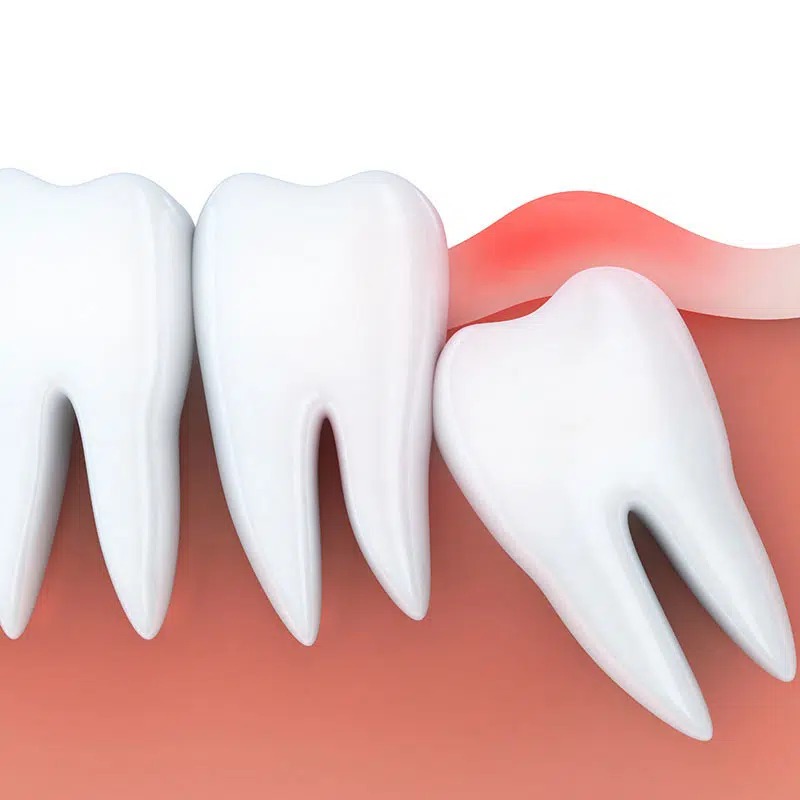

Wisdom teeth, or third molars, are the last teeth to develop, typically emerging between ages 17-25. Most people have four wisdom teeth—two upper and two lower—though some have fewer or none. These teeth were useful to our ancestors who had larger jaws and needed extra molars to chew tough, raw foods. However, modern humans have smaller jaws, often lacking sufficient space for wisdom teeth to emerge properly.
Why Wisdom Teeth Cause Problems
Impaction The most common wisdom teeth problem is impaction—when teeth cannot fully emerge through gums due to insufficient space. Impacted wisdom teeth may:
- Remain completely trapped in jawbone
- Partially emerge, creating an opening where bacteria accumulate
- Grow at angles toward or away from adjacent teeth
- Grow sideways, pushing against second molars
Types of Impaction:
- Soft Tissue Impaction: Tooth cannot break through gums
- Partial Bony Impaction: Tooth partially trapped in jawbone
- Complete Bony Impaction: Tooth entirely encased in jawbone
Problems Caused by Wisdom Teeth
Pain and Swelling Impacted wisdom teeth cause: throbbing pain in back of mouth, jaw pain and stiffness, swelling around the wisdom tooth area, difficulty opening mouth fully, and pain radiating to ear, head, or neck.
Pericoronitis (Infection) When wisdom teeth partially erupt, a flap of gum tissue often covers part of the tooth, creating a pocket where food and bacteria accumulate. This causes recurring infections characterized by: severe pain and swelling, bad taste and breath, difficulty swallowing, fever, and swollen lymph nodes. Pericoronitis requires immediate treatment.
Damage to Adjacent Teeth Wisdom teeth growing at angles push against second molars, causing: damage to adjacent tooth roots, increased cavity risk where teeth contact, resorption of second molar roots, and bone loss around second molars.
Crowding Though controversial, some orthodontists believe wisdom teeth contribute to crowding of front teeth as they push forward during eruption.
Cyst Formation Impacted wisdom teeth can develop fluid-filled sacs (cysts) that: damage surrounding bone, destroy adjacent teeth roots, and rarely develop into tumors requiring extensive surgery.
Tooth Decay Partially erupted wisdom teeth are extremely difficult to clean properly, making them highly cavity-prone. Decay often spreads to adjacent molars.
Gum Disease Partially erupted wisdom teeth create periodontal pockets where bacteria thrive, causing gum disease that can affect adjacent teeth.
When Wisdom Teeth Should Be Removed
Symptomatic Wisdom Teeth Removal is clearly indicated when wisdom teeth cause: pain, infection, cysts, damage to adjacent teeth, tooth decay, or gum disease.
Preventive Removal Many dentists recommend removing asymptomatic impacted wisdom teeth preventively in younger patients (late teens/early twenties) because:
- Surgery is easier when roots aren’t fully formed
- Healing is faster in younger patients
- Prevents future problems when removal becomes more complicated
- Risk of complications increases with age
Wisdom Teeth That Can Stay Wisdom teeth don’t require removal if they: fully erupt into correct positions, have adequate space and healthy surrounding tissues, can be properly cleaned, have no decay or gum disease, and don’t cause pain or problems.
Signs Your Wisdom Teeth Need Removal:
- Pain or discomfort in the back of your mouth
- Swelling and inflammation around wisdom tooth area
- Difficulty opening your jaw fully
- Red, swollen, or bleeding gums around wisdom teeth
- Persistent bad breath or unpleasant taste from infection
- Crowding or shifting of other teeth
- Recurring infections around partially erupted teeth
- Cysts or tumors around impacted wisdom teeth visible on X-rays
- Damage to adjacent second molars